Finding it hard to keep to a weekly / regular time slot to plough through the reading pile, but nice to dig in once in a while when I have a loose end – not enough brain to do focused work, but enough brain to do something constructive.
This time’s 12 links:
1. The Castlereagh Clock Tower: How a Monument to an Irish Lord ended up in Wales’s Ancient Capital on the Ramble and Studies in Welsh History blog – the article traces the origin of the clock tower which is at the centre of the crossroads in Machynlleth (spoiler: nobility and colonialism); there is also a mention of Plas Machynlleth (now a community and events venue) in which I facilitated a large event for the housing sector a few years ago.
Tags: Welsh
2. Dead link. Was an article on “the doughnut of social and planetary boundaries” on the Innovation Unit website.
3. Video about the book “Data Justice”, on the Data Justice Lab website. A 2’44” summary of the book’s contents. How do we advance social justice in the age of datafication? What are the implications of technology for democracy?
4. When Disagreement Is Inclusive by Todd Battistelli, reflecting on developing awareness of the lenses we bring to disagreements, including within groups and organisations working for social or environmental justice. He links to a piece by Maurice Mitchell about the patterns at work in progressive spaces, where he describes 10 patterns and common trends that occur within movements and organisations with social change missions – as well as strategies to work with and through them.
Tags: culture change, organisational learning, power, trust, values
5. The deep history of the National Eisteddfod festival on the Bylines Cymru website in 2024, the year the National Eisteddfod took place in Pontypridd.
Tags: Welsh
6. How Colonialism Spawned and Continues to Exacerbate the Climate Crisis by Anuradha Varanasi on the Columbia Climate School website. Ironic that I’m reading this in the hottest week of the year so far.
Colonialism was motivated by the promise of plundering the environment and subjugating populations. And the pervasive and persistent institutions of colonialism make it far more challenging to address the climate crisis and implement solutions, especially in a just and equitable way.
7. “How Complex Systems Fail” on the snazzy URL how.complexsystems.fail, by Richard I. Cook (University of Chicago).
- Complex systems are intrinsically hazardous systems.
- Complex systems are heavily and successfully defended against failure.
- Catastrophe requires multiple failures – single point failures are not enough.
- Complex systems contain changing mixtures of failures latent within them.
- Complex systems run in degraded mode.
- Catastrophe is always just around the corner.
- Post-accident attribution to a ‘root cause’ is fundamentally wrong.
- Hindsight biases post-accident assessments of human performance.
- Human operators have dual roles: as producers & as defenders against failure.
- All practitioner actions are gambles.
- Actions at the sharp end resolve all ambiguity.
- Human practitioners are the adaptable element of complex systems.
- Human expertise in complex systems is constantly changing.
- Change introduces new forms of failure.
- Views of ‘cause’ limit the effectiveness of defenses against future events.
- Safety is a characteristic of systems and not of their components.
- People continuously create safety.
- Failure free operations require experience with failure.
Tags: complexity, systems change
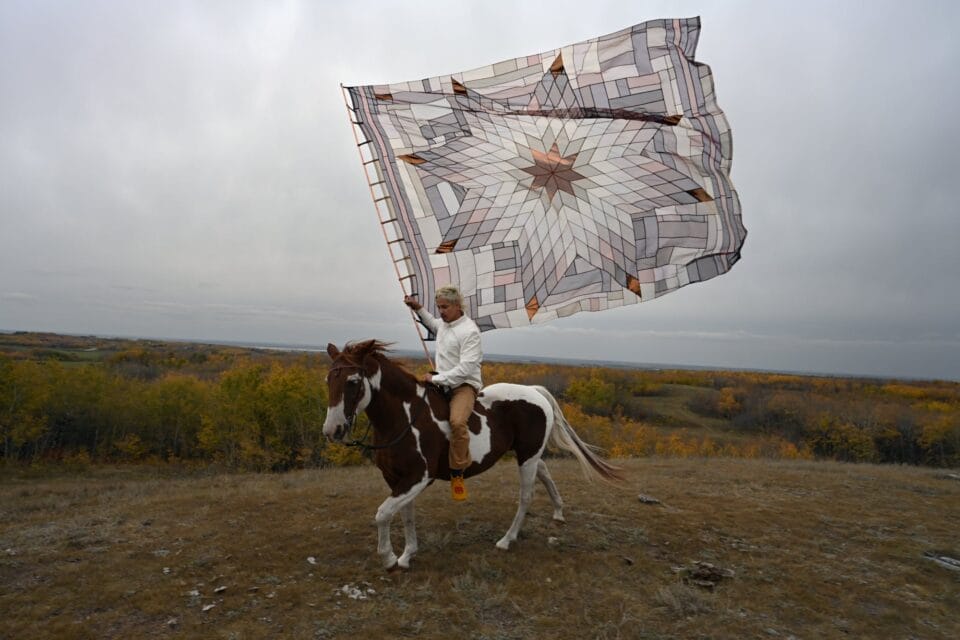
8. Vivid, Translucent Quilts by Wally Dion Stitch Together Indigenous Culture and Making Traditions – on the This Is Colossal website. (See photo below.)
I wanted to make several transparent quilts and superimpose them, one in front of another: a quilt for the microbiome, another for the bison, their manure and hooves, another for the summer fires that scorch the ground, and a final quilt for the sweetgrass braid. I was considering how all of these things worked together for thousands of years to create what is known as the “prairie ecosystem,” a vast and fertile expanse of land stretching from the foothills of Alberta to the banks of the Mississippi. I wanted to highlight the invisibility of systems when everything is working well, as it should be.
9. The Most Important Thing to Remember About Your Mother on The Marginalian.
Maria Popova (The Marginalian) writes: “They are just people who, however messy or painful our childhood may have been, and however complicated the adult relationship, have loved us the best way they knew how, with the cards they were dealt and the tools they had. It is a whole life’s work to accept this elemental fact, and a life’s triumph to accept it not with bitterness but with love.”
10. Bullying Trauma & the Healing Power of the Brain on ADDitude Mag – suggesting trauma-informed practices for neurodivergent children.
11. Hen wlad fy mamau (“my mother’s old country”), article by Rita Singer about notable women from Rhondda Cynon Taf. Rita works on Welsh literature, history and heritage, including on the Bywgraffiadur (the Dictionary of Welsh Biography).
Tags: Welsh
12. Trauma, Growth, and How to Be Twice as Alive: Tove Jansson on the Worm and the Art of Self-Renewal on The Marginalian. I love Tove Jansson’s books; she wrote the Moomins, but also other lovely and profound books. The Summer Book has been on my shelf for a while, I’ve pulled it down to read next.
Maria Popova (The Marginalian) writes: “We are always living with the awareness, conscious or unconscious, that life can sunder us at any given point without warning. This is the price of consciousness, which makes living both difficult and urgent.”